
Clerkships for career pivots?
Why stepping off the predictable path can pay off
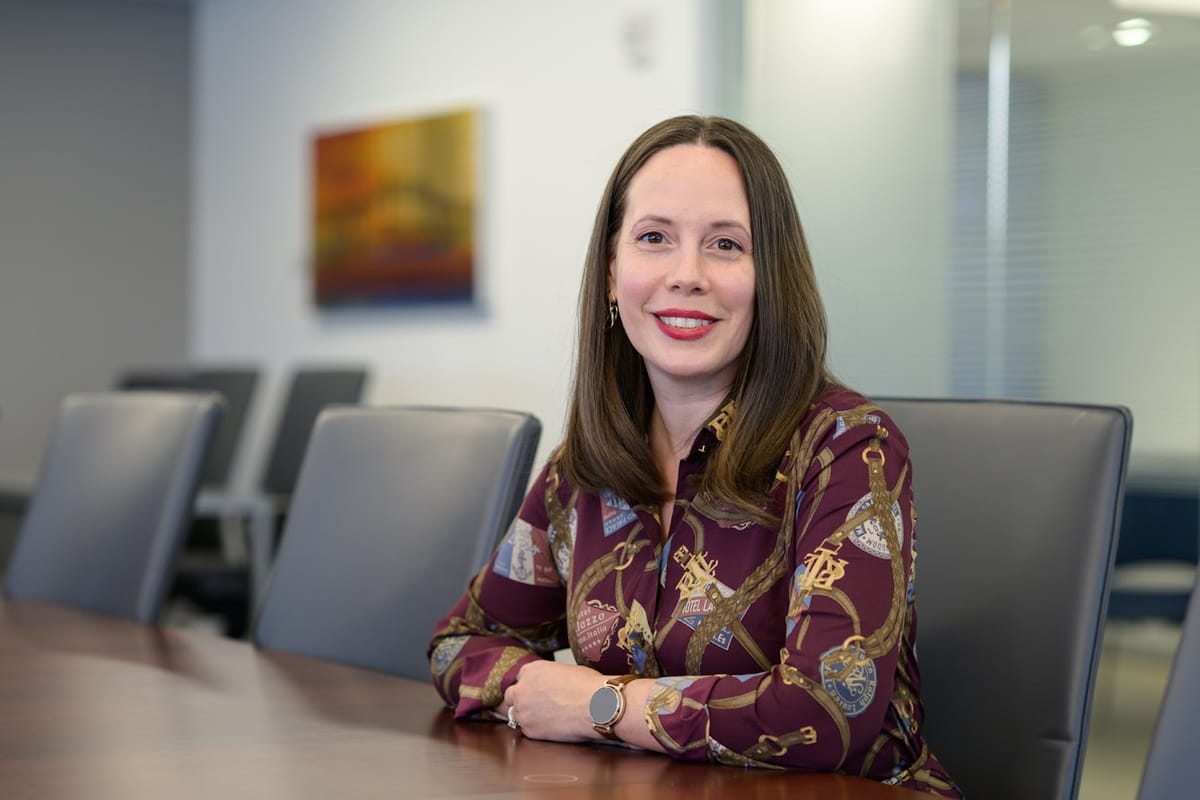

Most of us think of a clerkship as a launching pad; a first step toward bigger and better things. It isn’t a job many experienced attorneys consider taking. But Sylvia-Rebecca "Becky" Gutiérrez, assistant general counsel at Stevens Institute of Technology, thinks it is something more people should be open to.
She’s had not one, but two clerkships and both times she used them to make a major pivot in her legal career. Here, she shares how stepping into the judge’s chambers helped her see the law and her own ambitions differently.
—Interview by Emily Kelchen, edited by Bianca Prieto
You went from being a tax consultant at Deloitte to a state court appellate clerkship. After that, you were doing litigation at Day Pitney and Gibbons. Then you took a federal clerkship and went in-house. That’s quite the career path!
I’ve found joy and pride in the variety of my path. Each pivot taught me something different. Tax gave me exposure, litigation gave me grit, clerking gave me judgment and going in-house gave me integration. It’s been a rich, nonlinear path and I feel like it’s all added up to a kind of versatility that’s exciting to build on.
You’ve twice used clerking as a way to pivot. Did you know going into each clerkship what you wanted to do after it?
Each time, I was ready to make a change.
I didn’t think I could just walk from international tax into trial work, so I pursued a state clerkship. Essentially, that step served as the bridge that let me retool my skills and reposition myself as a litigator.
A few years in, I applied to the Office of the U.S. Attorney for the District of New Jersey. When I wasn’t selected, I decided to strengthen my candidacy by clerking federally. That experience was transformative. My judge was incredibly supportive. He gave me a criminal docket, encouraged me to observe AUSAs in court, and pushed me to grow as a writer and advocate.
I applied to the U.S. Attorney’s Office again during that clerkship, after all that exposure to federal criminal work, and I was told, “It wasn’t my time.” It was disappointing, but it also gave me clarity. I’d built deep experience: two clerkships, federal and appellate, a JD, an LL.M., the CIPP course for U.S. Privacy Professionals, and a strong reputation in local and national bar associations. Yet, law firms still wanted to bring me back as a junior associate. It didn’t make sense. I was ready for a role that valued judgment and versatility.
That’s when the opportunity at Stevens Institute of Technology came along. It brought everything together: my litigation background, my labor and employment work, my growing interest in data privacy. It was the right step.

What skills did you gain from your clerkship experiences that you wouldn’t have developed otherwise?
I gained something I don’t think I could have gained as quickly on the law-firm track: time and perspective.
As an associate at a firm, you’re focused on clients, deadlines and billable hours. You’re in the fight. A single case can take up a lot of your time over the course of several years. In chambers, you get to step back and see how that fight actually lands. You see what moves a judge, what falls flat and how credibility and clarity matter more than volume or aggression.
You learn to slow down, look at all sides and reach a reasoned outcome. Of course, in an institutional setting like Stevens, things move quickly, and you don’t always have the luxury of that pace. But my mother has an expression: “Vísteme despacio, que voy de prisa,” which means, “Dress me slowly, I’m in a hurry.” I think about that a lot. It’s a reminder that sometimes the fastest way is to take a breath and do it with great care.
What advice would you give to an attorney who is considering stepping off a predictable path for something less conventional?
I’d say, be intentional, not impulsive. Take the time to understand the “why,” and make sure it aligns with your core values. There’s no single “right” path in this profession, just the right path for you. Trust that the skills you’ve built will travel with you.
Predictability has its comforts, but growth rarely happens there. People have an extraordinary capacity to learn, adapt and rise to new challenges. And if you stay open and adaptable, you’ll be surprised by where it can lead. Every step in my career has built skills and judgment that continue to open new possibilities, sometimes in ways I couldn’t have planned.

You're all caught up!
Thanks for reading today's edition! You can reach the newsletter team at raisethebar@mynewsletter.co. We enjoy hearing from you.
Interested in advertising? Email us at newslettersales@mvfglobal.com
Was this email forwarded to you? Sign up here to get this newsletter every week.
Raise the Bar is written and curated by Emily Kelchen and edited by Bianca Prieto.


Comments ()